With this, multilateral lenders like the International Monetary Fund, the World Bank and the European Union may continue downgrading Pakistan, making its financial situation more precarious.
The Paris-headquartered FATF said Pakistan should continue to work on implementing its action plan to address its strategic deficiencies

The China-brokered deal between Iran and Saudi Arabia to revive diplomatic ties should not be a matter of concern for India as the pact would provide regional stability and would be beneficial for New Delhi's interests as well, Iranian ambassador Iraj Elahi said on Friday.

'...to bring the Global South and others to the negotiating table on the basis of Gandhi's non-violence so that we can leave a safer world for our children.'
Team Taiwan won't be at Winter Games opening ceremony

Dawood Ibrahim is wanted in India to face the law of the land for carrying out serial blasts in Mumbai in 1993 in which scores of people were killed and injured.
If Pakistan continues with the 'Grey List' or put in 'Dark Grey' list, it would be very difficult for the country to get financial aid from the IMF, the World Bank and the European Union, making its financial condition more precarious.
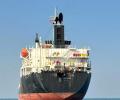
The world needs to wake up to this new dimension of war at sea and be prepared to face the 'unknown enemy' who have the advantage of attacking at their choice of location and time, cautions Commodore Venugopal Menon (retd).

The FATF continuing Pakistan in the 'Grey' list means its downgrading by IMF, World Bank, ADB, EU and also a reduction in risk rating by Moody's, S&P and Fitch.
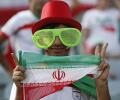

Other large recipients are China ($64 billion), the Philippines ($28 billion), Mexico ($24 billion), Nigeria ($21 billion), Egypt ($18 billion), Pakistan ($17 billion), Bangladesh ($15 billion), Vietnam ($11 billion) and Ukraine ($9 billion).

Modi is the first foreign leader to be invited to the palace by the Crown Prince, who appreciated the role played by Indian workers in the development of UAE as a modern nation, ministry of external affairs spokesperson Raveesh Kumar tweeted.

The attack did not result in any human losses, it said, adding that the remnants of the intercepted and destroyed ballistic missiles fell in separate areas around Abu Dhabi.

General Naravane's UAE and Saudi Arabia visits communicate India's long awaited arrival in the domain of integrated foreign policy where the diplomatic and the military domains both complement each other much more substantially, observes Lieutenant General Syed Ata Hasnain (retd).
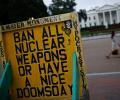
After 20 months of hectic negotiations, Iran and six major powers have reached a historic deal to limit Teheran's nuclear programme in return for lifting of sanctions. Let's understand closely what the deal is all about.
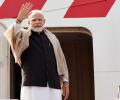
The prime minister's visit will begin from Palestine on February 10 after transiting through Jordan, where he will meet King Abdullah II.

The Middle East's power house is about to get a new ruler who is only 31 and he may lead Saudi Arabia for decades, says Ambassador M K Bhadrakumar.

'Did Trump hint at US military intervention in Qatar?' asks Ambassador M K Bhadrakumar.
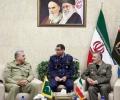
'Tehran senses that the Modi government is inexorably gravitating toward the US-Israeli-Saudi axis, jettisoning India's traditional independent Gulf policies,' notes Ambassador M K Bhadrakumar.

'It was China's rise that caused the New Cold War in Asia as it prompted the United States to rebalance its forces in Asia to experiment with engagement and containment at the same time,' says T P Sreenivasan.
'Here is a man who can steer the country out of the woods. That sense of hope towards Modi was already there. And now that he has actually visited this region, it will go to the next level.' Zafar Sareshwala, a close confidant of Prime Minister Narendra Modi, shares his impressions about the PM's historic visit to the United Arab Emirates.

'Qatar has been funding and supporting terrorist organisations.' 'It has used its media to spread lies and create unrest in neighbouring countries.'

In his address at a ministerial meeting of the SCO in Moscow in the Russian capital, Singh also referred to the Second World War and said its memories teach the globe the 'follies of aggression' of one state upon another that brings 'destruction' to all.

Its promise has fallen short before the onslaught of the votaries of the old order and ruthless extremist forces, notes Talmiz Ahmad.

India and Oman have thriving links rooted in centuries old people-to-people exchanges, Modi had said.
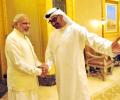
Apart from key bilateral issues, the two leaders also discussed situation in the region, particularly in wake of the increasing threat of terrorism and extremism from various sources including the Islamic State militant group.

Enabling labour to become more globally mobile can produce higher remittances with powerful 'brain gain' dividends.

Italy, Greece, South Korea, Taiwan and Turkey also figure in the list released by Pompeo, who said over 20 countries have cut their oil imports from Iran, reducing purchases by more than one million barrels per day.

The PM held wide-ranging talks with the Sultan of Oman and signed eight agreements, including pacts on cooperation in the field of defence, health and tourism.

Talmiz Ahmad is a former Indian ambassador to Saudi Arabia, Oman and the UAE. In an interview with Aditi Phadnis, he says the disequilibrium in Iraq will continue to prevail. Ahmad also says there are indications that the US is now anxious to avoid intervening militarily in West Asia, and that this is the appropriate moment for Asia to assume responsibility for its own security. Edited excerpts:

'At the very end of his speech, he dealt with the 'small problems' of Indian workers. But these measures did not seem to satisfy those who had expected the prime minister to find solutions for their problems. That the prime minister generally focused on broad policy issues and not on matters of detail left them bewildered,' says Ambassador T P Sreenivasan.
'Tehran,' Foreign Minister Zarif said, 'had expected the Modi government to be "more resilient" in the face of Washington's bullying,' notes Ambassador M K Bhadrakumar.

'The surge of Saudi nationalism is the last thing Washington wants,' says Ambassador M K Bhadrakumar.
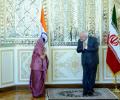
India's low passion, very cautious, relationship with Iran of the last 36 years awaits transformation, says Lieutenant General Syed Ata Hasnain (retd). Prime Minister Modi's visit cannot be a negotiating event; it is a symbolic one to strengthen the politico-diplomatic relationship.

Jaishankar is the first foreign secretary to head the Ministry of External Affairs as minister.
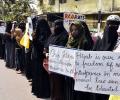
India and Indians can ignore Pakistan, but that cannot be said of other nations in the neighbourhood, where New Delhi's 'Neighbourhood First' policy constantly reverberates. Four of the eight SAARC member-nations are Muslim -- Afghanistan and Pakistan, Bangladesh and the Maldives. The rulers decide the nation's India or anti-India policy in the first two, and street-opinion contributes to the same in the latter two, points out N Sathiya Moorthy.
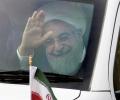
Hassan Rouhani to offer Friday prayers in Hyderabad's Mecca Masjid.

Iraq is on the verge of collapsing and foreign military intervention is inevitable. But for those who follow the developments in Iraq and the Middle-East will understand the current situation is nothing but a culmination of US and western policies toward the region, says Dr Waiel Awwad
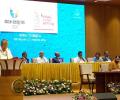
On matters relating to the Diaspora, the Centre needs to call the shots, suggests Ambassador T P S Sreenivasan.
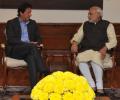
'The ceremony on May 30 is all about Modi and there is the great risk that Imran Khan who is a rockstar among Indians might end up stealing the show,' says Ambassador M K Bhadrakumar.
